
You get home from work. So does your partner. The dishes from last night are waiting, there’s a load of laundry that’s been sitting two days, the bin needs to go out before 8am, and all you want is ten minutes to breathe. That’s the moment resentment creeps in: “once again, I’m the one remembering everything.”
Good news: it’s not you, and it’s not your relationship. Nobody ever gave you a method that actually holds up. The chores themselves aren’t hard. It’s the mental load around them that wears you out. And that part can be fixed.
Here’s what works, tested in thousands of households, in 3 very unscientific steps.
1. Write it all down. Like, everything.#
When couples argue about housework, it’s almost always the same setup: one sees 40 tasks in their head, the other sees 8. Not out of bad will, out of invisibility.
Saturday morning exercise, over coffee: list together, on paper or in an app, everything that needs to happen in a week. Not just “do the groceries”. Break it down:
- Check the fridge
- Build the list
- Go to the store
- Put the groceries away
- Cook
- Clear the table
- Load the dishwasher
- Unload it
Yeah, every micro-task. It’s tedious, it’s a pain, and that’s exactly the point. Once the list is on paper, it leaves one person’s head and becomes a shared thing. That’s literally 50% of the job.
2. Give each task points (like a video game)#
Not all tasks are equal. Unloading the dishwasher is 2 minutes. Scrubbing the bathtub is 20 minutes plus a wrecked back. So why would you count them the same?
A simple grid that works:
- 5 points: the quick stuff (taking out the bins, hanging a load)
- 15 points: the annoying regulars (vacuum, quick bathroom clean, one laundry load with folding)
- 25 points: the heavy hits (full laundry, deep kitchen clean, windows, fridge)
Each person picks tasks during the week. Points add up. At the end, you can see at a glance who did what. 140 for you, 70 for them? Okay, we rebalance next weekend. No debate, no “you think I do nothing?”: the numbers are right there.
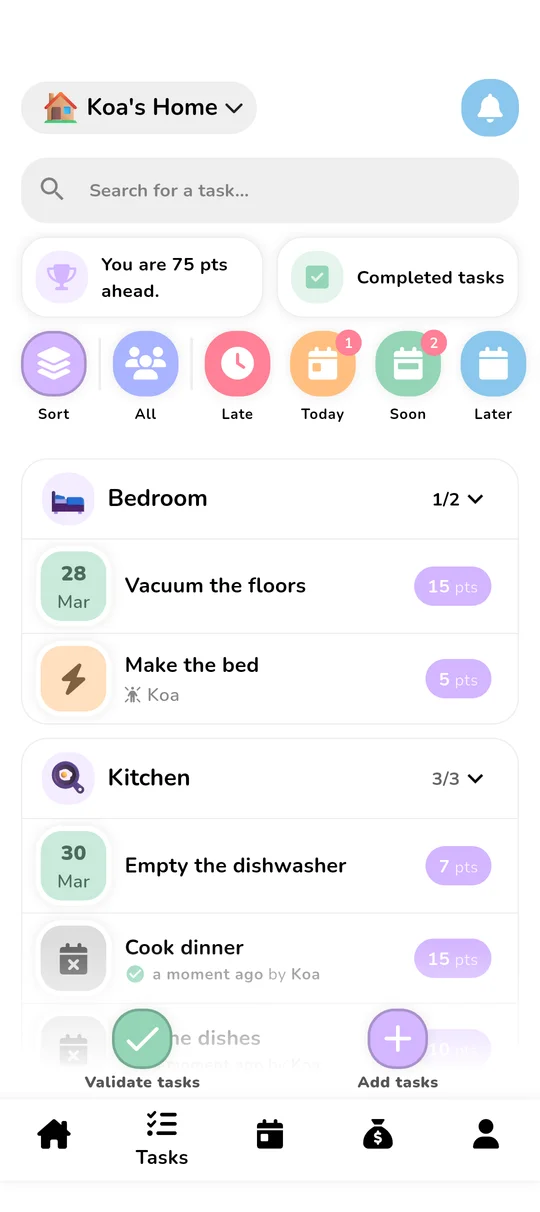
That’s exactly the idea behind Koabit, the mobile app we’re building for shared living (couples, roommates, families). You list your tasks, give them points, and whoever tops the week wins the Golden Broom 🏆. It’s intentionally ridiculous, and surprisingly effective: it defuses conversations that would otherwise get tense. More importantly, the list, points and leaderboard live in one shared place, so you don’t have to talk about it, you just see where you stand.
3. Automate what comes back on repeat#
Third real game-changer: 80% of tasks come back at the same rhythm. Bins are Tuesday. Vacuum is Sunday. Fridge is end of the month. Why should you have to think about any of it every time?
Automate once. For good.
- Every week: bins on Tuesday, vacuum on Sunday
- Every 2 weeks: bathroom, sheets
- Every month: fridge, expirations, freezer
- Every 3 months: deep clean (windows, skirting, vents)
In Koabit, the task recreates itself the second you validate the previous one. You go from “have to remember” to “already done”. You decide once, in a calm moment, and the system runs itself. Your mental load drops in one shot.
The 3 traps that wreck the method#
Even with the best grid in the world, certain dynamics sabotage it:
The Monday-night trial. If each of you checks what the other did with a sigh, it’s over. Points are for seeing balance over several weeks, not judging each day. A bad week is not a crime.
The “my way is the only right way”. If you secretly refold the towels because your partner folds them “wrong”, you’ve lost. You end up doing twice the work, they disengage. A shared standard beats the perfect standard every time.
Invisible tasks staying invisible. Booking the dentist. Thinking of a birthday gift. Checking the car’s paperwork. All of that is work. It belongs on the list, with points. Otherwise you spend your life carrying stuff no one sees.
After 2-3 months#
You stop counting. Not because you’re dropping the method, but because the automations have kicked in. Everyone knows what they’re doing, arguments about housework get rare, and you free up 2-3 hours a week of mental bandwidth.
Honestly? It’s the highest-return upgrade you can make for your relationship. Ahead of therapy, the romantic weekend, or the tidier bedroom.
This article is part of The complete guide to shared living, which also covers shared expenses, AI receipt scanning, mental load and the mood journal.
If household chores are a real topic at home, Koabit is literally built for this. Free, no ads, no subscription, on iOS and Android. Install it, create your household, invite your partner, and in two minutes everything’s in place. Weighted tasks, Golden Broom, auto-recurrence: everything we talked about in this article is in there. Future-you will thank you.