“It’s exhausting to have to think on everyone else’s behalf.” That sentence, repeated in thousands of households, sums up a phenomenon that has had a name for about a decade: mental load. It’s all the invisible tasks of organizing, anticipating and coordinating domestic life, and it pretty much always falls on the same person.
Contrary to popular belief, it doesn’t get solved by “helping more”. A partner who says “just ask me” doesn’t realize that asking is already mental load. You have to get out of that logic. Here are seven concrete levers that work, tested in very different households.
1. Externalize the mental list into a shared tool#
The first lever, and the most fundamental: get the list out of your head. As long as the schedule, tasks, appointments and things to buy live only in one person’s mind, no one else can grab them.
A shared tool (app, whiteboard, spreadsheet, whatever) changes everything. The moment a task is written in a common space, it becomes everyone’s. Its visibility lets anyone grab it. It stops being a silent reminder weighing on a single person. That’s exactly the method we detail in our dedicated guide on splitting household chores as a couple.
The trap: that the person who carried everything also becomes the one who writes everything. Then the tool doesn’t relieve much. Golden rule: in the first month, whoever carried less should write more.
2. Name and weight invisible tasks#
Mental load hides precisely in what has no name: “remembering birthday gifts”, “checking pharmacy stocks”, “anticipating that the oldest needs new shoes for back-to-school”, “booking the vet appointment”. These tasks never show up on a traditional to-do list.
Explicitly naming them transforms them. And giving them points (reflecting their real weight, not just execution time) forces you to recognize that “calling the plumber” is sometimes heavier than “vacuuming”.
3. One shared calendar for the whole household#
The agenda is often a blind spot. Each adult has their own (work, personal), kids have theirs (school, activities), and no one has a consolidated view. Result: one person anticipates scheduling conflicts and makes the trade-offs.
One shared calendar, aggregating every household event, shifts the load. A pediatrician appointment on the 12th? It shows up for everyone. School events, birthdays, holidays: all centralized.
Bonus: modern tools let you import existing external calendars (Google, Outlook, Apple via ICS) and export the common calendar to each person’s phone. No habit change needed, you just add a shared layer.
4. Move grocery lists into real time#
Grocery shopping is a concentrated micro-case of mental load. Who checks the fridge? Who builds the list? Who makes sure nothing’s missing? Usually the same person, who also ends up doing the shopping by default.
The fix is simple: a real-time shared grocery list. When someone notices there’s no more milk, they add it. When a kid finishes the cookies, they’re encouraged to add. The list becomes a living collective organism, not something run by one person.
When someone goes to the store, they open the list. It’s guaranteed up-to-date because everyone contributes.
5. Automate the budget#
Tracking shared expenses is another classic pocket of mental load. “Who paid what? Who owes what? We need to settle up at month-end.” Without a tool, the same person keeps the books.
An app that automatically computes balances removes half that load. Each person logs their expenses (AI receipt scan if needed), the app does the accounting. Going further: recurring expenses (rent, subs, internet) get registered once and auto-add each month. Nobody has to think about them. We walk through the 4 possible methods in the dedicated article on splitting expenses with roommates.
The conversation becomes: “I got a notif, the app says I owe you 47 € this month. Want me to transfer?”. Factual, not relational.
6. Institute a weekly check-in ritual#
Mental load is also a rebalancing problem. Today’s perfect split becomes unfair next week because a member had a work crunch, a kid got sick, or something unexpected threw off the schedule.
A short ritual (15 minutes on Sunday evening, for example) changes things. Minimalist agenda:
- How did the week go?
- Did any tasks drift from one member to another?
- What’s coming next week that we need to sort out now?
This ritual prevents accumulated micro-resentments. It lets you course-correct early, before the situation gets heavy.
Tip: the ritual works better paired with something pleasant (a drink, dessert, an episode after). The brain learns not to dread the exchange.
7. Rotate responsibilities#
Last practice, often overlooked: swap roles periodically. Every 3 months, change who handles admin, who thinks about gifts, who books medical appointments. Not to rigidly “equalize”, but because the person taking the role discovers the real complexity of the task.
Mental load is largely a problem of invisibility to those not carrying it. Someone who’s never handled school payments thinks it’s “one click”. When they do it the first time, they realize you have to log into 3 platforms, dig up info, juggle deadlines. That realization is priceless.
The trap to avoid: over-tooling#
Scrolling this list, you might be tempted to install 5 different apps. That’s a mistake. Multiplying tools recreates mental load of another kind: knowing where what lives.
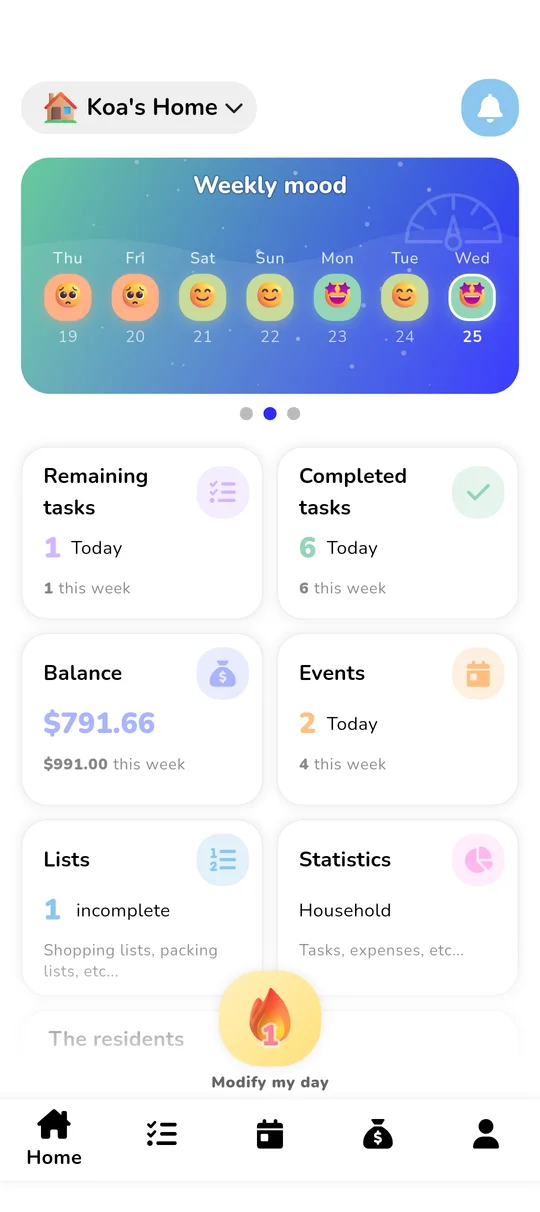
The right strategy is the opposite: one place for everything (tasks, calendar, expenses, lists, mood). That’s precisely why we built Koabit: a free mobile app that bundles these five aspects in a single interface. The cognitive effort to use the tool becomes negligible, and that’s exactly the goal.
After a few months#
Households that put these practices in place all report the same thing: it’s not the house that changes, it’s the atmosphere. The person who carried everything finally feels relief. The one who carried less discovers an active engagement that nourishes them too. And disputes that regularly surfaced around daily life become rare, not by magic, but because the subject has been addressed structurally instead of emotionally at each flare-up.
Mental load isn’t a curse. It’s an organizational problem with concrete solutions. These seven levers aren’t exhaustive, but they cover 80% of the ground. Adopting them gradually (not all at once) is usually the best strategy.
This article is part of The complete guide to shared living, which also covers household chores, shared expenses, AI receipt scanning and the mood journal.
If mental load is a real topic at home, Koabit is literally built for this. The 7 levers from this article, we condensed them into one app: weighted tasks, shared calendar, budget + AI receipt scanning, real-time lists, mood journal. Free, no ads, no subs, on iOS and Android. Install it, create your household, invite the others, and in two minutes everything’s in place. The highest-return upgrade you can make to your daily life together.